The 8 Parts of Speech:
You've Got To Learn 'Em
The 8 parts of speech? What are those?
All of the words that we use in our writing and speaking can be divided into just 8 groups, or parts of speech.
Don't you think that is amazing? I do!
Think of how many words we use all of the time. Now try to wrap your brain around the fact that there are only 8 types of words. I think it's shocking!
Okay, enough of my disbelief...
I'll show and tell you about each of the 8 parts of speech.
The 8 Parts of Speech
There is a lot to learn about the 8 parts of speech, but right here, we're focusing on the essentials.
If you want to have a thorough understanding of the 8 parts of speech (which I highly recommend), you'll have to do a little more studying!
1. Nouns
Nouns name people, places, things, or ideas.Examples: mother, cat, kitchen, Paris, table, freedom
Sentences:
2. Pronouns
Pronouns take the place of nouns.Examples: I, she, we, us, someone, whom, who, myself, you
Sentences:
3. Verbs
Verbs express an action or a state of being.Examples: run, hop, think, dream, imagine (action verbs)
is, am, are, being, was, seem, look, (linking verbs)
Sentences:
It's because of this that I have pages devoted to teaching you more about verbs. You'll learn about action verbs, linking verbs, and subject-verb agreement later.
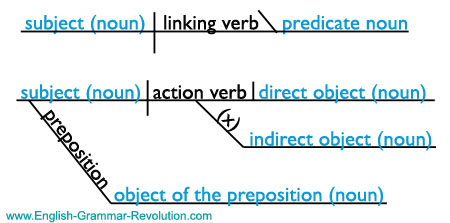
Verbs are diagrammed on a horizontal line to the right of the subject.

4. Adjectives
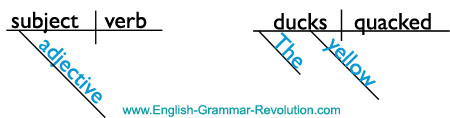
Adjectives describe nouns and pronouns.Examples: a, John's, purple, five, some, amazing
Sentences:
-
1. Which one? (blue book)
2. What kind? (chocolate cake)
3. How many? (some candy)
4. Whose? (Bob's uncle)
5. Adverbs
Adverbs modify verbs, adjectives, and other adverbs.Examples: playfully, happily, majestically, here, there, everywhere, very,
Sentences:
-
1. How? (danced gracefully)
2. When? (danced yesterday)
3. Where? (danced here)
4. Why? (Danced because she loved it)
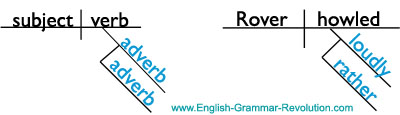
Adverbs are diagrammed on a slanted line underneath the verb, adjective, or adverb that they are modifying.
6. Prepositions
Prepositions describe the relationship between a noun or a pronoun and some other element in the rest of the sentence.Yes. It's not just you. That definition sounds very complicated.
Prepositions get my vote for "Second Most Complicated Part of Speech."
Examples: above, at, after, behind, for, from, in, into, up, over
Sentences:
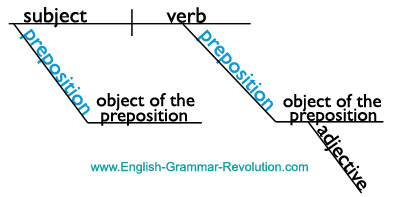
The noun or pronoun after a preposition is called the object of the preposition. The objects of the prepositions are: tree, river, stripes, and sleeve.
Prepositions are diagrammed on a slanted line under the word which they are relating the object of the preposition to. The object of the preposition goes on a horizontal line after the preposition.
7. Conjunctions
Conjunctions join two or more words, phrases, or clauses.Examples: for, and, but, or, nor, because, while, if
Sentences:
-
1. Coordinating conjunctions join things that are the same, and there are only seven of these. (for, and, nor, but, or, yet, so)
2. Correlative conjunctions are always used in pairs. (either...or, both...and)
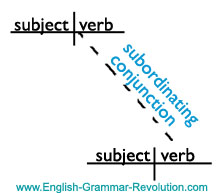
3. Subordinating conjunctions join dependent clauses with independent clauses. There are many subordinating conjunctions. (because, while, whenever, since, if...)

8. Interjections
Interjections show emotion.Examples: wow, holy cow, rats, oh no, congratulations, yes, dang, yuck
Sentences:
That means that they don't modify or describe anything. They stand alone and are not related to anything else.
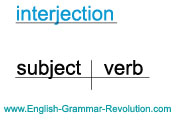
Interjections are diagrammed on a line floating above the subject. You can see from the sentence diagram that interjections aren't grammatically related to the rest of the sentence.
Congratulations! You just finished learning about the 8 parts of speech! How did it go? Do you think you could close your eyes and name all 8 parts of speech?
Give it a shot and then give yourself a pat on the back.
Take a little coffee break and come back to learn more when your brain cells are rebooted!

Tidak ada komentar:
Posting Komentar